

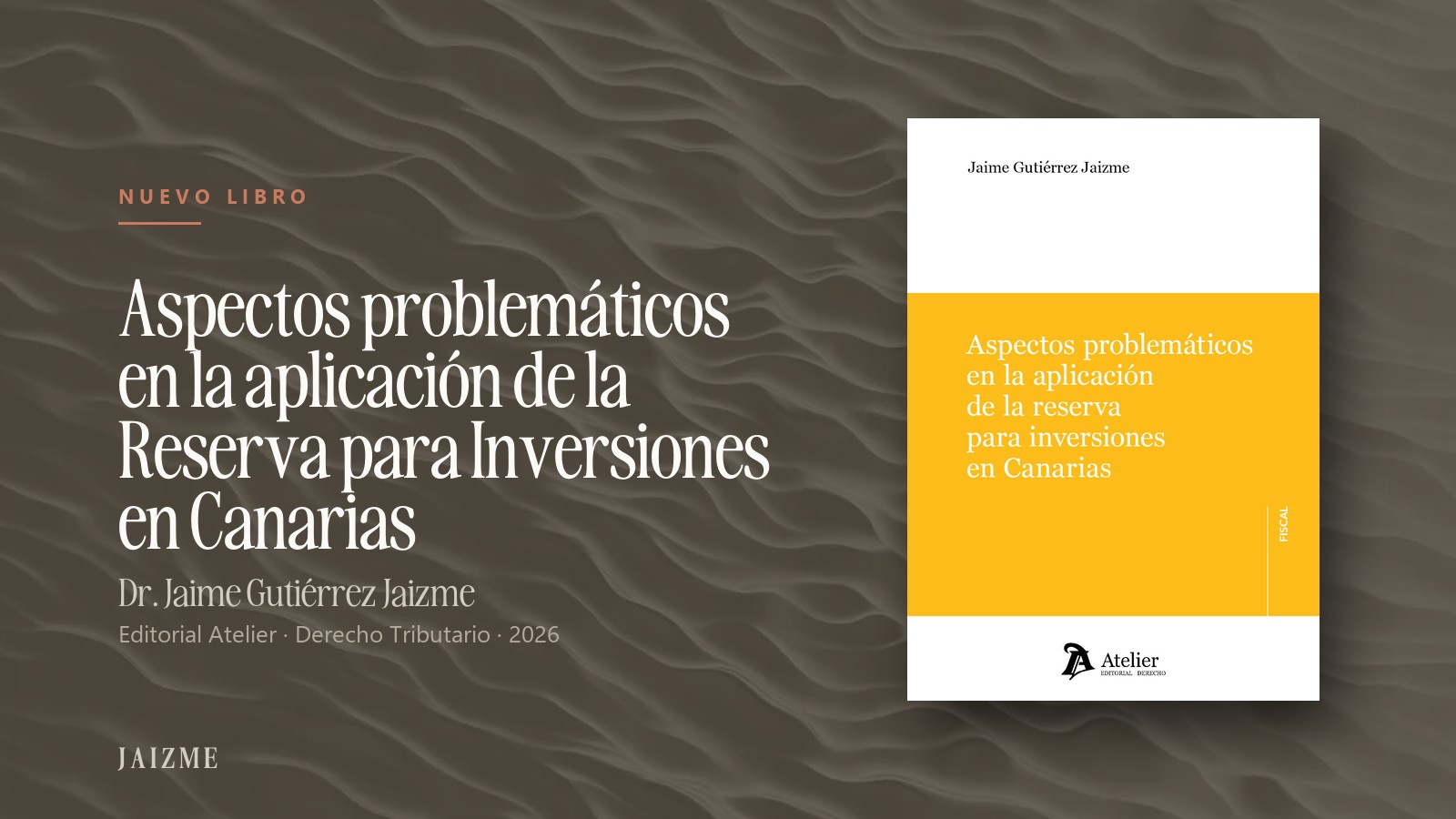
Jaime Gutiérrez Jaizme, founder of JAIZME and PhD in Tax Law, publishes with Atelier an in-depth analysis of the RIC: requirements, grey areas and reform proposals.
Dr. Jaime Gutiérrez Jaizme, founder of JAIZME and PhD in Tax Law from the University of La Laguna, has just published with the legal publisher Atelier the monograph “Aspectos problemáticos en la aplicación de la Reserva para Inversiones en Canarias” (Problematic Aspects in the Application of the Canary Islands Investment Reserve), a 334-page study that dissects, with a practical focus, the most relevant — and most contentious — tax incentive of the Canary Islands Economic and Tax Regime.
A decisive incentive, and one of the most litigated
The Canary Islands Investment Reserve (RIC), regulated in Article 27 of Law 19/1994, allows companies and professionals operating in the islands to reduce their tax burden very significantly in exchange for reinvesting part of their profits in the archipelago. In economic terms it is probably the highest-impact mechanism of all those that make up the REF.
That relevance, however, coexists with considerable technical complexity. Successive legislative reforms, drafting deficiencies and legal gaps have forced administrative doctrine and the courts to intervene time and again to define the scope of its requirements. The result is an incentive that many companies apply with a permanent sense of uncertainty: doubts about which investments qualify, when materialisation is deemed to be fulfilled, or how the limitation period operates for each tax year.
What the book contributes
The book offers an exhaustive, theoretical and practical analysis of the legal regime of the RIC, and focuses precisely on the grey areas that generate disputes. Among other questions, the study addresses:
- The historical background of the incentive and the evolution of its regulation up to the current framework.
- The subjective requirements applicable to the different types of companies and, in particular, to tax groups.
- The allocation and materialisation phases, with their deadlines and the investments that qualify.
- The tax limitation period of the incentive, one of the most frequent sources of controversy.
- The main obstacles that the lack of regulatory clarity poses for business planning in the Canary Islands.
Building on that diagnosis, the book does not stop at describing the problem: it puts forward reform proposals aimed at simplifying the regime, strengthening legal certainty and ensuring that the RIC genuinely fulfils its purpose as an instrument for investment and economic development in the islands.
“The RIC is one of the tax incentives of greatest economic relevance in the Spanish tax system and, at the same time, a figure characterised by its high complexity and litigiousness.”
An open-access book
The monograph is published in Atelier’s Tax Law collection in Open Access mode, under a Creative Commons licence (CC BY-NC-ND 4.0), so its content can be consulted freely. It has ISBN 979-13-88250-24-8 and the permanent digital identifier DOI 10.71237/z2fop5nqa2. The printed edition is available on the publisher’s website.
About the author
Jaime Gutiérrez Jaizme holds a PhD in Tax Law from the University of La Laguna and is a tax lawyer registered with the Santa Cruz de Tenerife Bar Association. After an earlier career at Garrigues, he combines professional practice with teaching as a lecturer in Financial and Tax Law at the ULL. He is the founder of JAIZME, from where he advises companies, self-employed professionals and individuals on tax, corporate and employment matters, with a particular focus on the incentives of the REF: the RIC, the Canary Islands Special Zone (ZEC) and the deduction for investments in the Canary Islands.
Does your company apply the RIC?
Allocating and materialising the Canary Islands Investment Reserve correctly requires planning and rigour: a non-qualifying investment or a miscalculated deadline can turn a tax saving into a reassessment with interest and penalties. At JAIZME we support our clients throughout the whole life cycle of the incentive, from the preliminary analysis to defence in a tax audit.
If you would like to review how you are applying the RIC, or assess whether your company could benefit from it, see our advisory service on the Canary Islands REF or contact us and we will look into it with you.
Did you find this article useful? Get in touch with us for more information.
Contact